Molecular cloud formation: Impact of metallicity, far-UV and CR heating using SILCC-Zoom simulations
Author: Sanjit Pal
Molecular clouds (MCs) are defined as cold, dense regions of the interstellar medium in which stars are believed to form. However, the processes surrounding their formation and evolution, particularly in metal-poor environments, continue to be subjects of active research. To explore this, high-resolution zoom-in simulations have been utilised within the SILCC-Zoom framework, which is based on the FLASH code.
Preliminary work has been carried out using SILCC-Zoom, but this is the first set of zoom-in simulations that include radiative feedback under the comparative lens of metallicity, far-UV interstellar radiation field (FUV ISRF), and cosmic ray ionisation rate (CRIR). We examine two metallicities that are comparable to Milky Way-like environments (1.0 Z⊙) and Large Magellanic Cloud-like environments (0.5 Z⊙). Multiple simulations are performed under both static and adaptive ISRF / CRIR (see Rathjen et al. 2024; Brugaletta et al. 2025 for details on the implementation). With this setup, we perform three MC zoom-ins using recent SILCC simulations: 0.5 Z⊙–A (adaptive), 0.5 Z⊙–S (static), and 1.0 Z⊙–A; the 1.0 Z⊙–S is from Seifried et al. 2020.
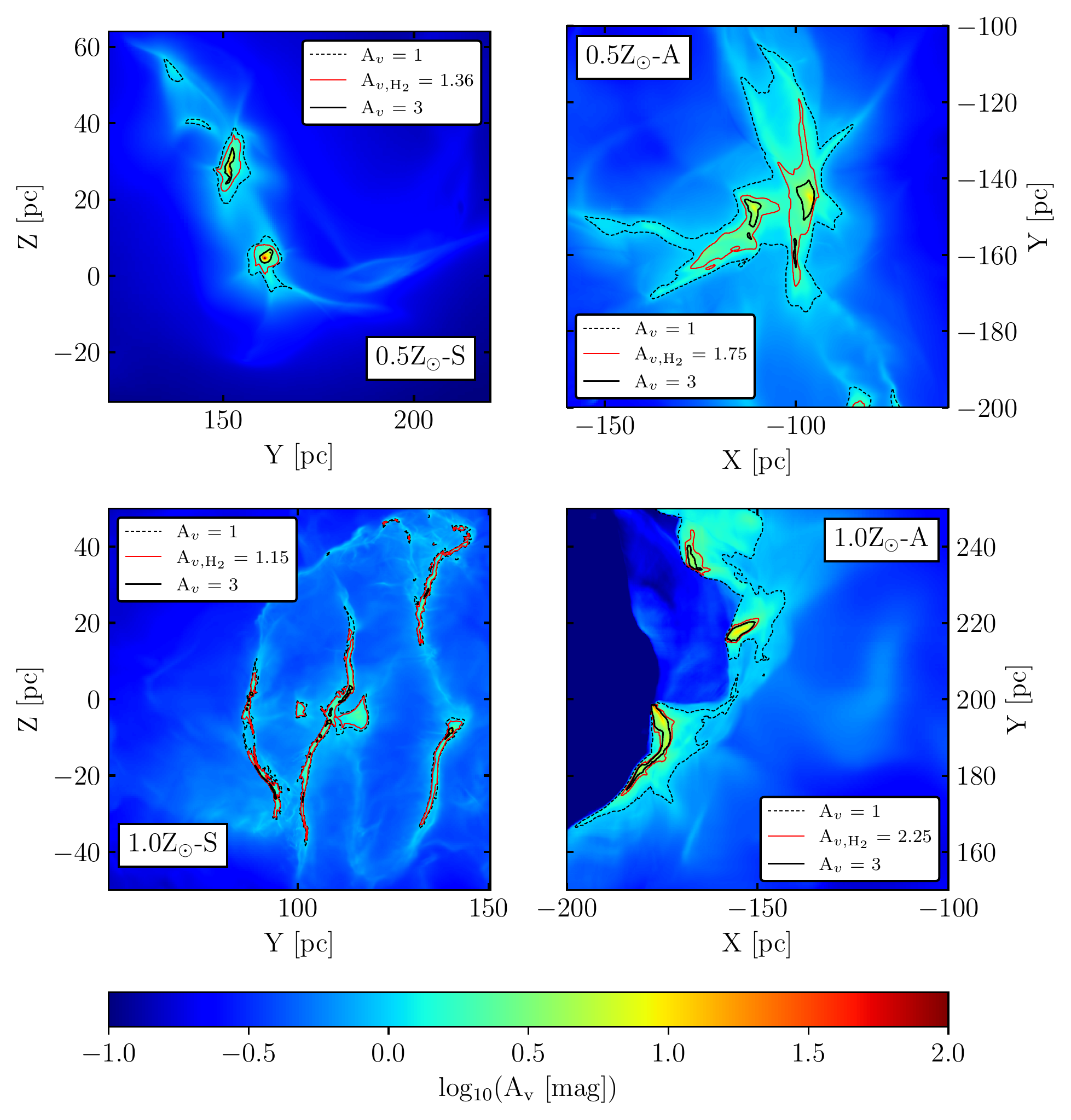
Fig. 1 presents visual extinction contours for Av = 1, 3, and the H2 formation threshold. Broadly, the extinction at which H2 forms is higher for adaptive simulations due to more accurate modelling of heating mechanisms that lead to more inherent star formation in these environments which increases the stellar contributions that lead to molecular dissociation.
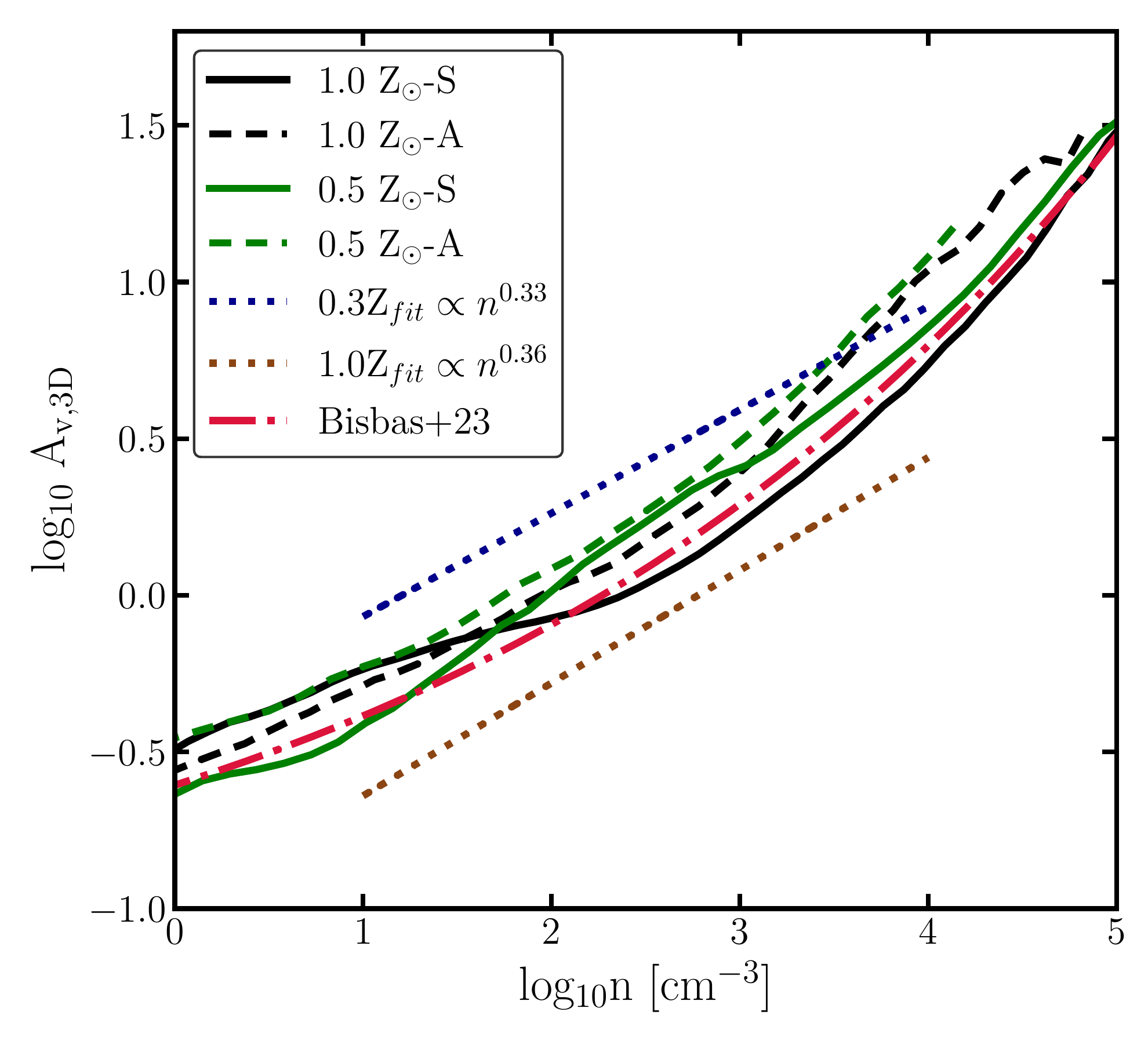
Fig. 2 presents a comparison of Av values against theoretical fits derived from the works of Hu et al. (2021) and Bisbas et al. (2023). It is evident that adaptive runs consistently yield higher Av at a given number density, n.
Observational studies use CO to trace H2, yet, given that CO formation is restricted to denser regions, a conversion factor is necessary as it is difficult to infer the MC exactly. With these simulations, the next step is to use it to constrain this CO-to-H2 conversion factor with synthetic observations by using radiative transfer codes such as RADMC-3D.