SUPPRESSION OF CO CLUMP FORMATION BY MAGNETIC FIELDS
The understanding the structural and chemical evolution of molecular clouds could provide us with a better insight to the conditions leading to star formation.
We address this task by hydrodynamical simulations realised by 3D AMR code FLASH. We study cloud formation in two colliding magnetised flows of various strenght of the magnetic field, which varies from 0 to 5μG.
At the beginning, the magnetic field lines are parallel with the flow velocity. The simulations include the chemistry model of Nelson & Langer (1997), which is used to track the chemical evolution of some abundant gas species including CO molecule.
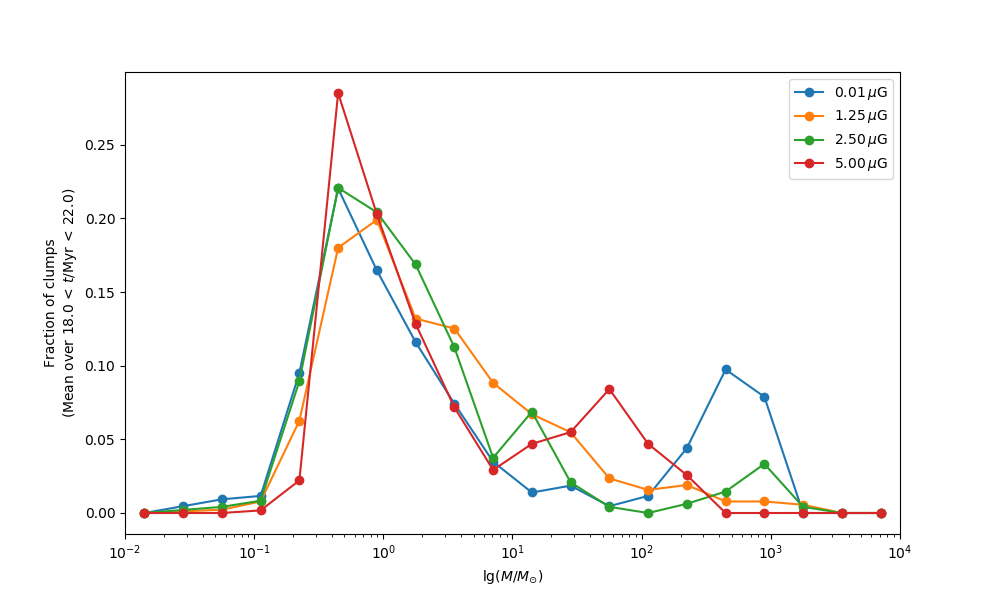
We detect the forming molecular clumps in CO by the Fellwalker algorithm (Berry 2014). This analysis is done on snapshots taken at different time throughout the simulations. Then, the clump mass function can be calculated; the time-averaged clump mass function for models with different magnetic field strength B is shown in the figure. We do not see that the presence of the magnetic fields, or their strength suppresses or promotes formation of higher mass clumps in respect to lower mass clumps. Thus, these tentative results indicate that the clump mass function is largely unaffected by the value of B (at least up to 5μG).