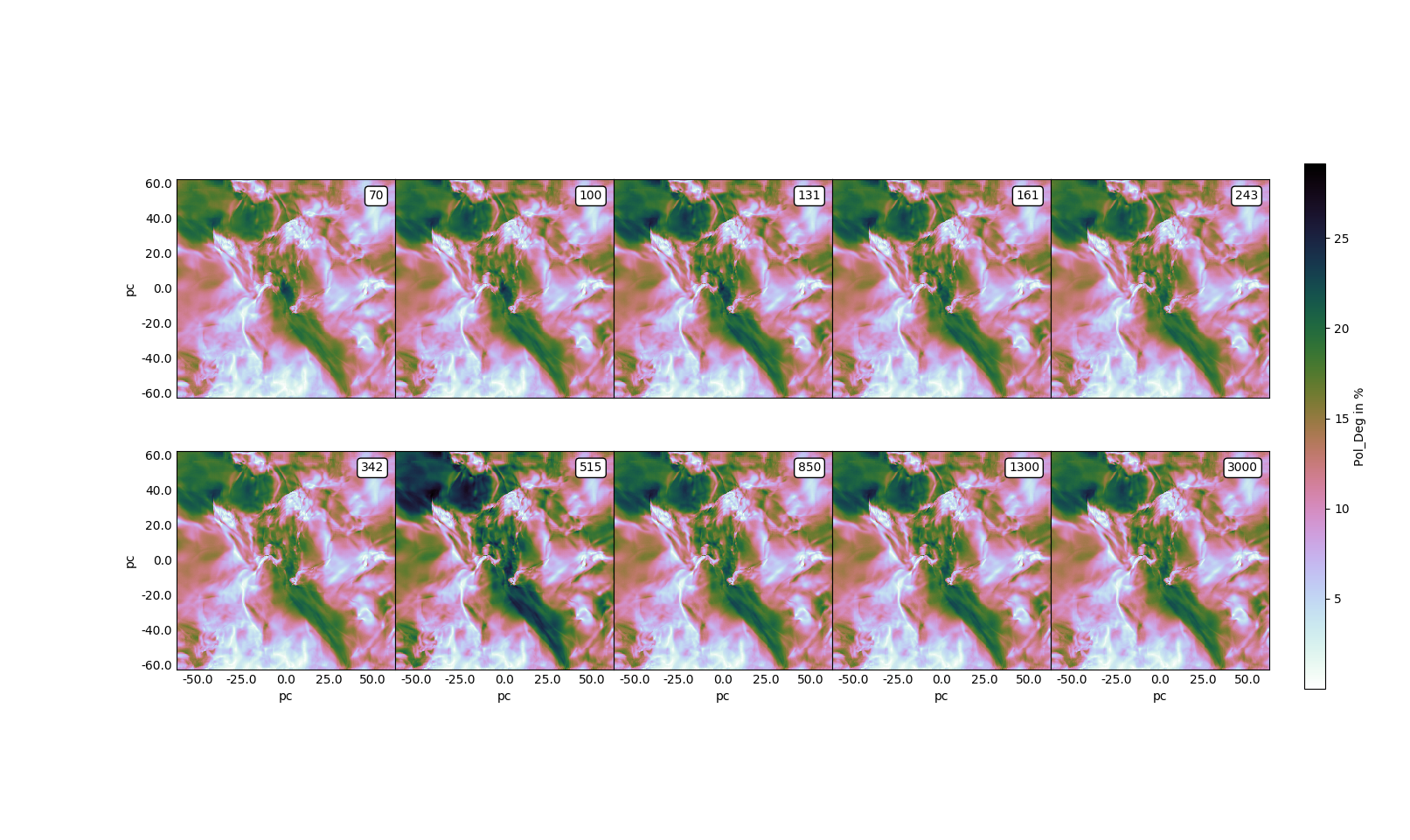
POLARISATION DEGREE AT DIFFERENT WAVELENGTHS
Dust in the interstellar medium (ISM), albeit constituting only ∼1% the mass of the gas, plays an important role in many ISM processes like cooling or the formation of molecules. Dust also allows us to trace and measure the magnetic field as it polarises the incoming light. In this picture, dust grains of shapes of prolate spheroids align their longer axes perpendicular to the magnetic field, and gyrate in the plane perpendicular to the magnetic field. The common alignment causes the incident light to be linearly polarised; the polarisation degree can be significant (up to ≈15%).
We perform synthetic observations of dust grain polarisation on magnetohydrodynamic simulations. The simulations are zoom-in regions of a stratified galactic disc of resolution 0.1 pc calculated within the SILCC project.
The synthetic observations are performed by POLARIS code (Reissl et. al. 2016). For the synthetic observations, we applied a dust grain model of maximum dust size of 2 micron, and dust alignment according to the radiative torque (RAT) mechanism. We analyse the dust re-emission at ten different wavelengths from 70 μm to 3000 μm.
We also find that feedback from young massive stars increases the polarisation degree at shorter wavelengths, particularly in the vicinity of the source. The closer to the source, the higher the polarisation degree at shorter wavelengths (λ≲300 μm). The polarisation degree at longer wavelengths is largely independent on the distance to the source.