IMPACT OF B FIELDS AND RADIATIVE FEEDBACK ON CO EMISSION
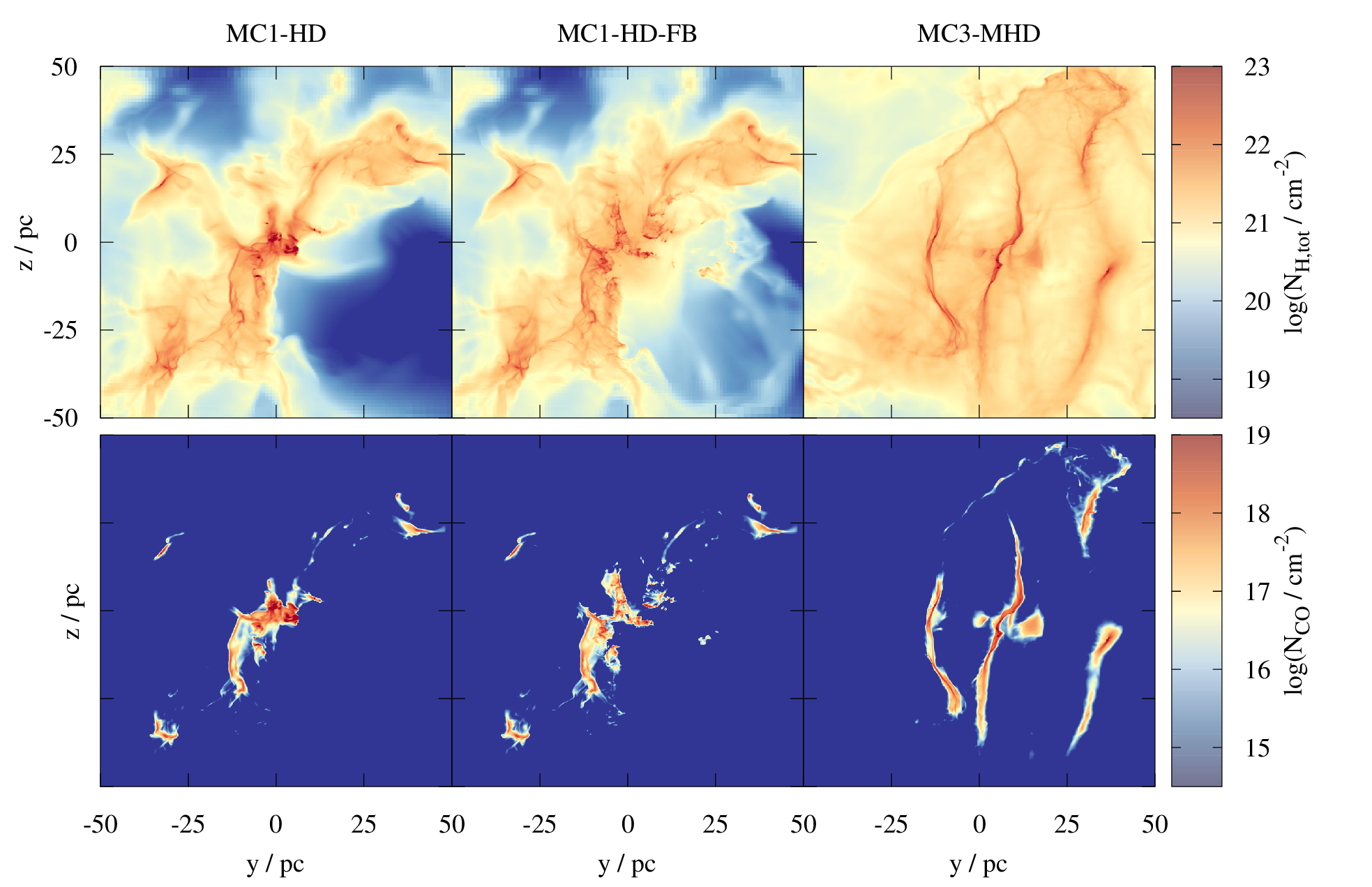
Within the SILCC-Zoom project, we study the impact of magnetic fields and radiative stellar feedback on the emission of CO using the CO, J=1-0 line. In Seifried et al., 2019 ( arxiv:1906.01015 ), we present a detailed analysis of the CO emission and its dependence on the local cloud properties.
We show that CO-bright gas is associated with gas below a temperature of ~50 K and above a density of ~300cm−3. The amount of CO-dark gas scales with the amount of gas at low visual extinction (AV<1.5) and a significant fraction (up to 65%) of the H2 can be CO-dark. We also show that the large range of cloud conditions causes the XCO factors of the various clouds to have a large spread of up to a factor of 4 around a fiducial value of about 1.5×1020cm−2(Kkms−1)−1. This significantly affects the accuracy of determining the H2 mass of molecular clouds and their virial state.
In order to overcome this problem, we suggest a new method to determine the H2 mass of molecular clouds. It relies on the availability of CO, J=1-0 observations and AV maps. It reduces the uncertainty of the clouds’ overall H2 mass to a factor of ~1.8 and is also applicable for sub-pc-scaled structures of the clouds.