OBSERVATION OF SUPERNOVA REMNANT INTERACTING WITH MOLECULAR CLOUD
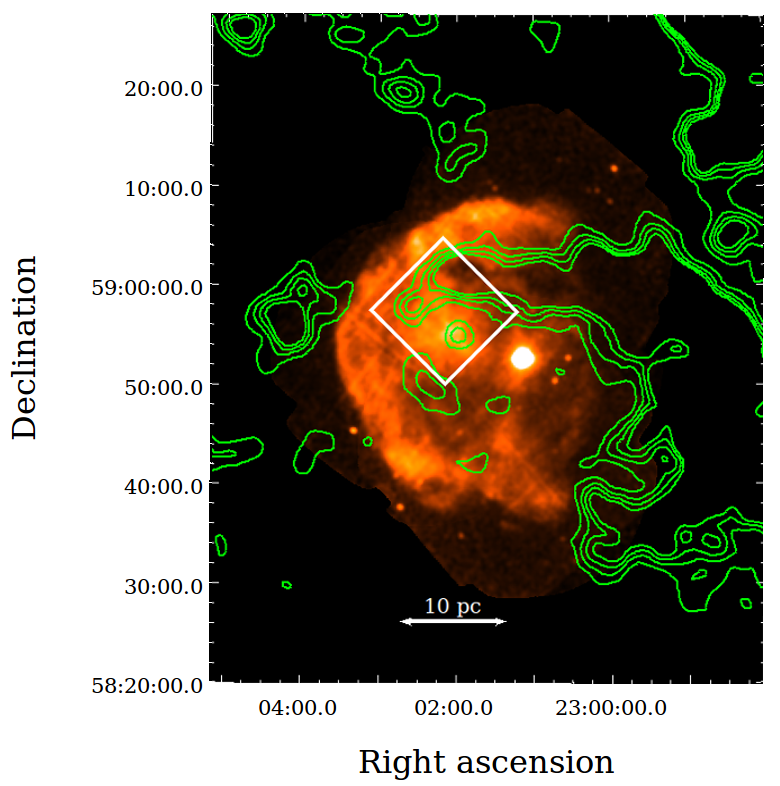
It is rare to find supernova remnants (SNRs) interacting with their nascent clouds despite the short lifetimes of massive stars. This is due to the fact that supernovae are typically clustered and the first supernova will clear the molecular cloud; subsequent supernovae then explode in the rarefied post-shock gas. One example of a SNR interacting with a giant molecular cloud (GMC) is CTB 109. CTB 109 is an X-ray luminous SNR, located at a distance of 3.2 kpc in the Perseus arm. Due to its semicircular morphology in both X-ray and radio, it is thought that the SNR shock has encountered the GMC and been stopped. Parts of the GMC extend in-front of CTB 109 and are seen in absorption in the X-rays, the most prominent being the "CO-arm" (Figure 1). Thus CTB 109 is an excellent site to study the impact a SNR shock has on an extended high column density cloud.
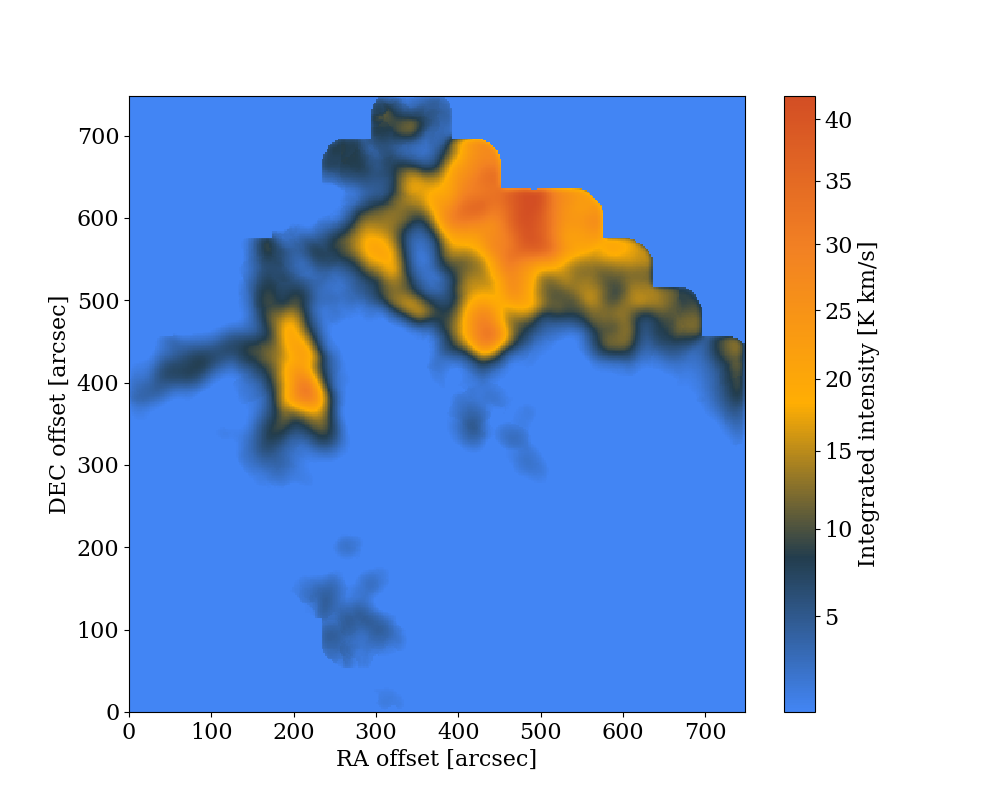
We have observed the easternmost tip of the CO arm using the IRAM 30m telescope. Our observations include the CO (J=1-0) and (J=2-1) lines for the 3 main isotopologues, HCN (J=1-0), HNC (J=1-0), HCO+ (J=1-0), N2H+ (J=1-0) and SiO (J=2-1) and (J=5-4). The moment zero map of 12CO (1-0) is shown in figure 2. Using the 13CO (2-1) / 13CO (1-0) ratio and the 13CO (2-1) / 12CO (2-1) ratio we are able to constrain the physical properties of the emitting gas along each line-of-sight using the RADEX code. We find that there exists a thick layer of hot (>100 K) dense CO-bright gas at the edge of the cloud. Chemical and thermodynamic modelling using our X-ray code suggests that to achieve temperatures above 100 K at these densities, while maintaining a high fractional abundance of CO, the UV flux must be very low (< 0.001 G0) for CO not to be dissociated, while the cosmic ray ionisation rate is high (~10−14 s-1) or the X-ray flux is very high (~ 0.1 erg/cm2/s) to heat the gas. Thus, the heating cannot be due to the background interstellar radiation field but due to the high cosmic ray and/or X-ray flux produced by CTB 109.